skip to main |
skip to sidebar
If there’s anything that I envy about those who attend more “liturgical” churches, it’s the opportunity to serve as lectors. In fact, the more I think about this, the more convinced I become that the office of lector is the single greatest honor that could be bestowed upon a Christian.
For starters, the position is relatively safe. A preacher or teacher, for instance, must be constantly on the guard against speaking error. Not so the lector! What could be safer than proclaiming the Scriptures directly? How could the Word of God speak more clearly, than on its own terms?

Additionally, it seems worth mentioning that Jesus himself served as a lector in his home synagogue. Luke 4:16-21 relates:
He went to Nazareth, where he had been brought up, and on the Sabbath day he went into the synagogue, as was his custom. And he stood up to read. The scroll of the prophet Isaiah was handed to him. Unrolling it, he found the place where it is written:
“The Spirit of the Lord is on me,
because he has anointed me
to preach good news to the poor.
He has sent me to proclaim freedom for the prisoners
and recovery of sight for the blind,
to release the oppressed,
to proclaim the year of the Lord’s favor.”
Then he rolled up the scroll, gave it back to the attendant and sat down. The eyes of everyone in the synagogue were fastened on him, and he began by saying to them, “Today this scripture is fulfilled in your hearing.”

Likewise, in 1Timothy 4:13 Paul urges Timothy, “Until I come, devote yourself to the public reading of Scripture.”
Justin Martyr, writing about 155 AD, relates how each Sunday “The memoirs of the apostles and the writings of the prophets are read, as much as time permits.”

The Scriptures, of course, were written in a highly illiterate society, and only in recent centuries have Bibles become available to the masses. For the better part of history, Scripture was received almost exclusively through oral proclamation. In light of this information, how important is the office of lector! What a privilege, to be the mouthpiece of God! What an honor, to convey his very words to his people!
Of course, it isn’t likely that my church will be instituting lectors anytime soon. They are, it would seem, a dying tradition of the church, being quickly discarded by today’s literate world. Even so, we might all do well to pray:
Lord, anoint me to preach good news, to proclaim freedom, to proclaim the year of the Lord’s favor!

I have a confession. I collect Bibles. All kinds of Bibles. I’ve tried cutting back in the past. I sorted through them, selecting the volumes I was willing to part with. I donated some to Goodwill, and donated others to the library’s quarterly book sale. Some I gave to friends. And yet, strangely, the collection only seems to have grown larger.
It’s grown so much, in fact, that I’ve recently been forced to re-organize it into seven sub-groups.
1. Original Language Bibles. If it’s Hebrew or Greek, I just can’t let it go.
2. English Translation Bibles. It’s my goal to have as many translations as possible represented in my collection. Currently, I stand at thirty.
3. Foreign Language Bibles. Of course I don’t have any real purpose for a Bible in, say, Chinese - but how can I let go of a book written in such a beautiful script? That it incidentally happens to be a Bible is just a bonus.

4. Special Bibles. Everything from Study Bibles, to Audio Bibles, to Bibles with special features or formats.
5. Sentimental Bibles. A few that were gifts, and several that I’ve “marked up” over the last ten years. These are the Bibles I’ve come to know the best, the ones I’ve carried with me and used for my devotional reading. They represent, perhaps, the most justified sub-group of my collection.

6. On-Location Bibles. Because you never know when you’re going to need a Bible on the go. I keep one in my pocket, one by my bedside, and a third in my car’s glove box.
7. Display Bibles. These are the ones I can really show off. A few small scrolls, a handwritten Book of Esther, a tiny Sefer Tehillim inserted into a keychain.


Put together, there are about fifty Bibles in these combined collections. I know that I don’t need so many, and yet each one seems to be a legitimate “keeper.” Perhaps this wouldn’t be so bad, except for the constant drive I feel to buy yet more. I used to tell myself, “This will be the last one, and my collection will be complete.” Now I know better than to believe such empty words. There will always be another Bible.
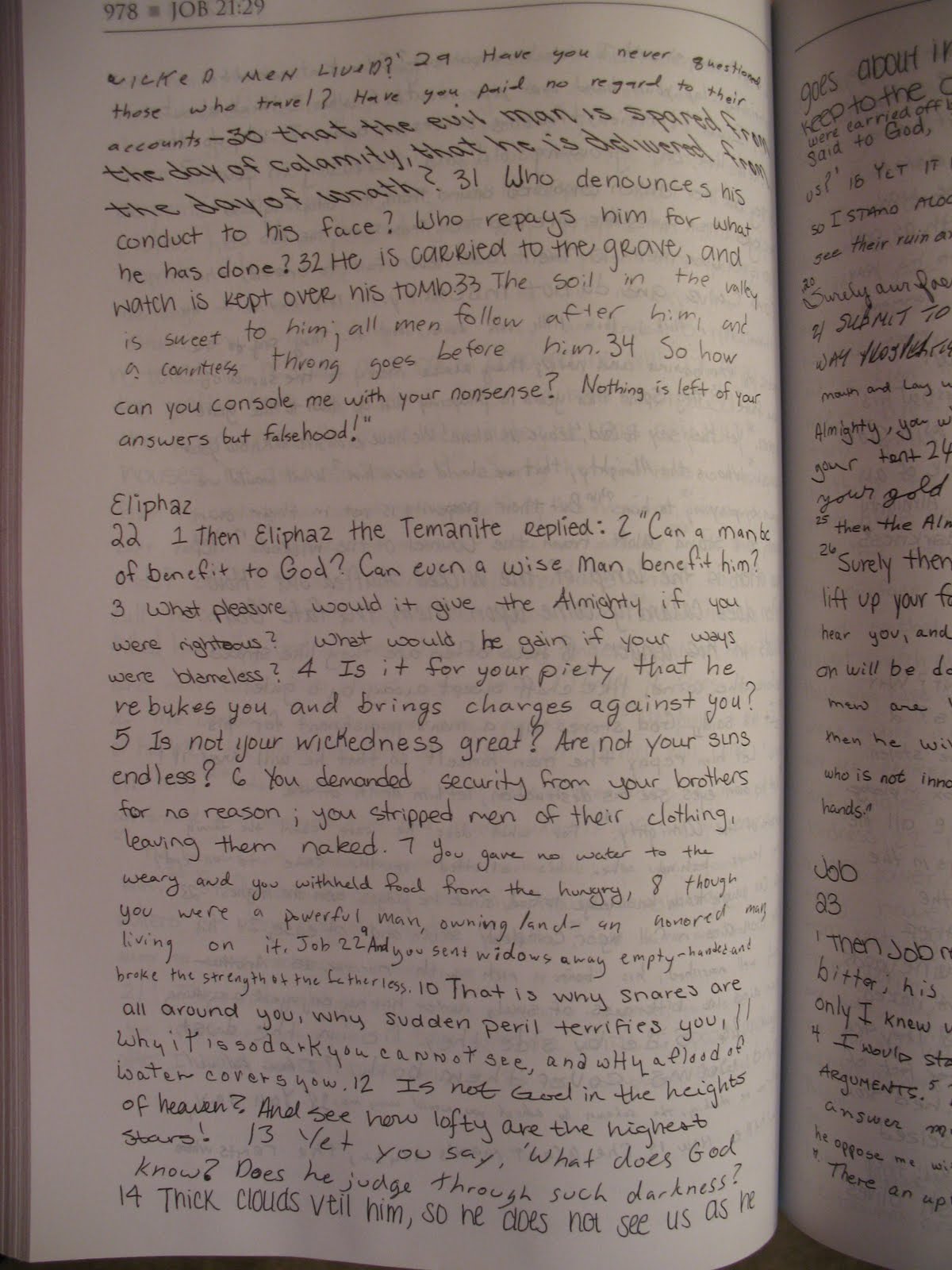
Just a few weeks ago, I found myself at the local Christian bookstore flipping through the NIV 30th anniversary edition “Bible Across America.” I knew, of course, that I didn’t really need another NIV. In fact, I had nine of them already. But this one was different: Each verse was handwritten by a different individual. Over 30,000 people had helped to complete the project. How could I resist such a symbolic throwback to the days before Gutenberg? I had to have it.

And my wish-list continues to grow. How can I be satisfied with a collection that lacks, for example, Everett Fox’s brilliant translation of the Torah? Or such historically important translations as the Latin Vulgate, the Douay-Rheims Version, or a facsimile of the original Geneva Bible? What about Genesis 1 inscribed on an egg? Or the entire Bible on a keychain? Perhaps I should take it a step further and buy the Bible inscribed in micro-print on a single crystal. (Never mind I could never read it without a microscope – it’s written in Latin anyhow.) And on and on it goes.

Of course, my wife is less than thrilled by my addiction - and understandably so. As I continue dragging home new copies of the book I already own, she watches helplessly while our free shelf space continues to disappear. My Bible collection has slowly spread from one shelf, to two, to three, to an entire bookcase. And now they've begun their infiltration atop another. If they continue at this rate, we’ll soon own more copies of Scripture than the stores I’m buying them from.

It’s not as if I don’t read them. I work my way through the Bible a minimum of once every year. And it’s not as if I don’t use all of the Bibles in my collection (sans the Foreign Language collection, perhaps.) I vary the translation I’m using almost weekly. I review the notes in my Study Bibles daily. And I consult my Hebrew and Greek Bibles at least on occasion.
So why do I feel so guilty? Perhaps it’s the knowledge that so many Christians through history couldn’t own even a single Bible if they’d wanted to. Perhaps it’s the knowledge that, at the end of the day, seven or eight versions are more than sufficient to represent the translation spectrum. Perhaps it’s just sympathy for my poor wife, many of whose books are now re-located to the closet.
And yet, as I write this, I find my mind wandering to the next addition. In just a few weeks, I’ll have saved enough of my personal spending money (a mere $30 a week) to purchase a leaf from a Latin Bible hand-written in a French monastery around the year 1260. Never mind the fifty-some Bibles I already own: none of them is more than sixty years old. This is an incredible 750 years old. And while it will be, by far, the most expensive piece I’ve bought to date, somehow I know that it’s worth it. And I know that it will be a huge step towards finally completing my collection.
For now, at least.




![Dead Sea Scroll [Isaiah], 120 BC](https://blogger.googleusercontent.com/img/b/R29vZ2xl/AVvXsEgAzndLJ0W5o8DrmVi4VTu5BuA9ybYhvm4XzAhfh8HGrkW0Xj5S-fn1UVogFmQsX1BYpmFTbeDHyYoCNtCQNy12neGN6HOf7xneTDHxGqYFsutJRr0QURfXagz3yFuw66LgIiiyjDtVnqI/s220/1.jpg)
![Codex Vaticanus [2Thessalonians/Hebrews], 325 AD](https://blogger.googleusercontent.com/img/b/R29vZ2xl/AVvXsEiKWcVifygfXapyrHehk-iDwvf0i1tUO1ktEaoLGPerHjV4gVwhmyGJazdig6Xtg307z8pDdXhyphenhyphenIfagpNJ3rSOyAUkSJh0mkqYfoQMTHXqw7Pi1tRhcgCLb2TKfBZ5A8QkRZ_eXQzmsJhg/s220/2.jpg)
![Codex Argenteus [Gospels], 550 AD](https://blogger.googleusercontent.com/img/b/R29vZ2xl/AVvXsEiSiheg90nSc7l74mqaFQadzow9UCT0ftxV5u9JthVFeOtBXunApMtheYsFimq6xOj_vY3v6mLs5t5bAzzCCp0uG2TqGUK7rhx7nXGRTXswjbB4D9UN8v-fViJa3S__9y77kbNhp6HBRAk/s220/3.jpg)
![Book Of Kells [Matthew], 800 AD](https://blogger.googleusercontent.com/img/b/R29vZ2xl/AVvXsEiPeCNdHfbIYRnCTRD3hAxvmgb66vop6fgKXZb4_CXHm9FIa1J5U3SfNMhiKZ9urWy-8XLmGsJPXrfo_-CeN3heALwp-N18oCyliblsXQ56x1cHS1NRFNJ1jJV_FEABSTrBVyNg2-UrThY/s220/4.JPG)
![Illuminated Vulgate [Genesis], 1310 AD](https://blogger.googleusercontent.com/img/b/R29vZ2xl/AVvXsEhiEXXFf7AX1527EkkR9TKzmP0N8CSjQE4lHgYTk7XWSfvlWiYkPNpkdxwkeXXeAO3p6tRkFyIccIB_Ejmh6CKLXUo4rVU5NT18wkbGTIQcbTzAk4NwdhXUgNCJYDkkvAAftTszdqB8Bnk/s220/5.JPG)
![Gutenberg Bible [Judges], 1455 AD](https://blogger.googleusercontent.com/img/b/R29vZ2xl/AVvXsEjD_u7tgrWTz4HfsoAnbTFRckvRZnlnIcQ5LmRXQQX_INc458x91MKrW3GlAtmVL8rriR-yGwyCusMA12c5rXoJrJJuh2QqsgudY8T5Bnrigzf0LQaZmUMC3z9x76CRvi49JBYZmGrRoAk/s220/6.jpg)
![German Bible [2Thessalonians/1Timothy], 1480 AD](https://blogger.googleusercontent.com/img/b/R29vZ2xl/AVvXsEjEAjaSKhnQe0TD_vjZY-aWOKPmicKtQX828GUONXxklNLcejI4M9DEHqI-zSg_-Zbww5pgT8UdhQB_Gy3OM38jXNCd-WUKLSS9tjBRRiESWL3aWL_D3T5w5e7599aEDjd4hIo5wJ_SIUw/s220/7.JPG)
![Geneva Bible [John], 1607 AD](https://blogger.googleusercontent.com/img/b/R29vZ2xl/AVvXsEhOOswKH6Lyy6lGkFCxIPzSJVbxTeY7_HE1g4OpIx_r37rJqPWXwq5ZR1Wih3A9u60cf5E-Iwiu7KM30xughQos7gmnUY7HsV7FS21suNGJTSFPNoTwYV9kal3-_SS8nSRnHDdoGrpGswM/s220/8.jpg)
![Ryrie Study Bible [Genesis], Modern](https://blogger.googleusercontent.com/img/b/R29vZ2xl/AVvXsEj17A3uWwFEoZQ71lfwoY0lLaz8GWIzZqtus9kOPOFoO1LMzkhim0ix3GKYH1Mvdj9jq32PLow5lUr87xMXUqnL_EU3RDEWw3LpXUld7Q_M30_trGXclv6Iv_vXzTiYpUalnJRnsnrD9ks/s220/9.jpg)
![IPhone Bible [Romans], Modern](https://blogger.googleusercontent.com/img/b/R29vZ2xl/AVvXsEjr_q4JWDoJAk8aku7mbLAobxokTiyOeRzc2KQMepUClni7e-AXmeKz8rbbjw8vYeMnbgyabUtrDBeAYI0QJ0Wq44fvCW7QGvcSSUDeMsgW9dRvOdhMDJlH9kawDjdnRKJl5lOilywoDZ4/s220/10.jpg)


